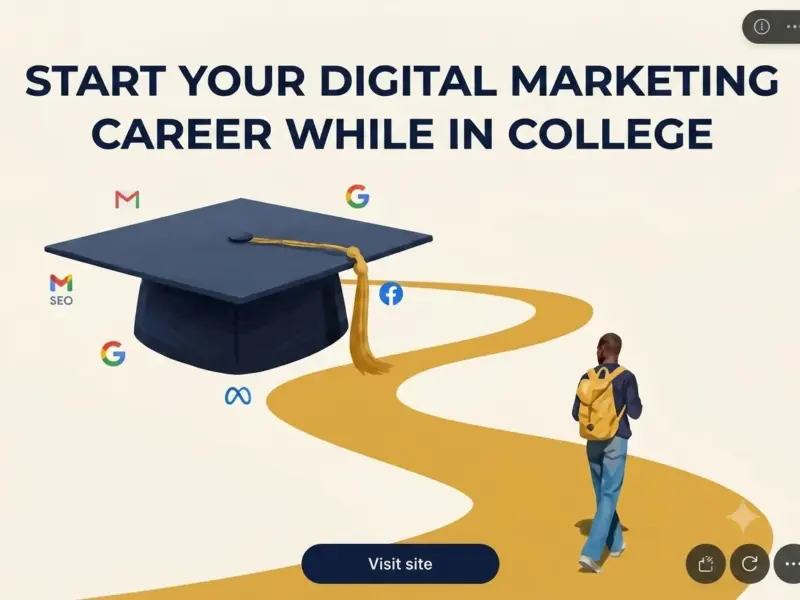
From Student to Digital Marketing Consultant: A Career Guide for Beginners


Many students begin digital marketing with a simple goal: learn the tools, complete a course and get a job.
That is a good starting point. But learning tools alone will not make someone a digital marketing consultant.
A consultant must understand the business behind the campaign. They should be able to identify why marketing is not producing enough enquiries, why leads are not converting and what changes could improve the result.
After working in digital marketing for more than eight years across education, FMCG branding, architecture and consultancy, I have learned that most marketing problems are not caused by a single platform.
The real issue may be an unclear audience, a weak offer, poor content, an ineffective landing page, missing tracking or slow sales follow-up.
This is why the journey from student to consultant is not about collecting more tools and certificates. It is about developing practical experience, business understanding and better judgment.
What Does a Digital Marketing Consultant Do?
A digital marketing consultant helps businesses use digital channels to attract the right customers and generate measurable results.
The work may include:
- Understanding the business model
- Researching customers and competitors
- Clarifying the offer
- Choosing suitable marketing channels
- Planning content and advertising
- Improving websites and landing pages
- Setting up tracking
- Reviewing lead quality
- Improving CRM and follow-up
- Measuring customer acquisition and revenue
A consultant should not begin every conversation by recommending Meta Ads, Google Ads or SEO.
The first step is to understand the problem.
A good consultant asks:
- Who is the real customer?
- What does the customer need?
- Why should they choose this business?
- What is stopping them from taking action?
- Where can we reach them?
- What happens after an enquiry arrives?
- How will we measure the final result?
The right platform can be selected only after these questions are answered.
Can a Beginner Become a Consultant?
A beginner can start preparing for a consulting career. However, completing a course does not immediately make someone a consultant.
Consulting ability develops through real experience.
You need to understand what happens when:
- A campaign gets clicks but no enquiries
- Leads are cheap but do not convert
- Good advertisements send users to a weak landing page
- The sales team responds late
- Customers do not understand the offer
- Campaign data and sales data do not match
- A strategy that worked for one industry fails in another
A realistic career journey may look like this:
Student → Intern → Digital Marketing Executive → Specialist → Strategist → Consultant
Each stage teaches a different level of responsibility.
Do not rush to use the consultant title. First, focus on becoming useful to the business.
1. Learn Marketing Before Platforms
Beginners usually start with tools such as Meta Ads Manager, Google Ads, Canva, WordPress and AI platforms.
These tools are useful, but tools do not create strategy.
Start by understanding three fundamentals.
Customer Research
Before planning a campaign, understand:
- Who the customer is
- What problem they want solved
- What doubts they have
- What alternatives they are considering
- What price range they expect
- What proof they need
- How urgently they need the solution
Without customer research, most marketing decisions are based on assumptions.
The Offer
The offer is the reason a customer should take the next step.
For example, “Digital marketing course available” is only an announcement.
A stronger offer explains:
- Who the course is suitable for
- What the student will learn
- Whether live projects are included
- What support is provided
- How the training is delivered
- What action the student should take next
The same principle applies to an architect, consultant, clinic or retail brand.
The Customer Journey
Customers rarely purchase after seeing one advertisement.
They may first discover the brand, compare options, visit the website, check proof, ask questions and discuss the decision with someone else.
A simple journey may look like this:
Awareness → Interest → Trust → Enquiry → Follow-Up → Decision → Sale
A consultant must understand the complete journey, not only the advertisement that started it.
2. Understand the Main Digital Marketing Channels
Beginners should understand the purpose of the main channels before choosing a specialisation.
Search Engine Optimisation
SEO helps businesses appear when customers search for relevant information, products or services.
Important beginner skills include:
- Keyword research
- Search intent
- On-page SEO
- Content planning
- Internal linking
- Local SEO
- Technical SEO basics
- Google Search Console
SEO is not simply adding keywords to a page. The content must genuinely answer what the user is searching for.
Performance Marketing
Performance marketing uses paid campaigns to generate leads, bookings, applications or sales.
Important skills include:
- Selecting the correct campaign objective
- Audience research
- Advertisement copy
- Creative testing
- Conversion tracking
- Budget management
- Lead-quality analysis
- Customer acquisition measurement
Publishing an advertisement is the easy part. Understanding why it does or does not generate profitable customers is the real skill.
Content Marketing
Content helps businesses build awareness, trust and demand.
It may include:
- Blogs
- Videos
- Social media posts
- Landing pages
- Emails
- Case studies
- Customer stories
Content should not be created only to fill a monthly calendar.
Every piece should support a clear customer need or business objective.
Analytics, CRM and Follow-Up
Marketing does not end when an enquiry arrives.
Students should also understand:
- Website traffic
- Conversion rates
- Qualified leads
- Appointment rates
- Cost per sale
- CRM stages
- Follow-up systems
- Revenue and return on ad spend
A marketer who understands both campaigns and what happens after the lead arrives can provide more valuable recommendations.
3. Stop Thinking Like a Social Media Poster
One of the most common beginner mistakes is believing that digital marketing means posting regularly on social media.
Posting can keep a brand visible. But posting alone does not guarantee enquiries or sales.
I have reviewed businesses that published content every day but had no clear:
- Target customer
- Offer
- Lead-generation plan
- Landing page
- Tracking system
- Follow-up process
The content received reach and engagement, but it was not connected to a business outcome.
Every post should have a purpose.
It may:
- Create awareness
- Explain a problem
- Educate the customer
- Answer an objection
- Build trust
- Present proof
- Promote an offer
- Generate an enquiry
A marketer should be able to explain why the content is being created and what the customer should do next.
4. Work on Real Projects
You cannot develop consulting skills only by watching videos.
Real projects teach you how customers, platforms, budgets, deadlines and sales teams behave.
A student can begin with:
- A personal website
- A local business
- A college programme
- A family business
- A volunteer organisation
- An internship
- A self-created project
Your first project does not require a large advertising budget.
You can start by creating:
- An SEO audit
- A competitor analysis
- A keyword plan
- A content strategy
- A landing-page review
- A Google Business Profile plan
- A sample advertising strategy
- A basic lead follow-up process
The goal is to practise how you investigate and solve a business problem.
5. Build a Portfolio That Shows Your Thinking
A portfolio filled with certificates and poster designs does not fully show your marketing ability.
A strong case study should explain:
The Business
What does the business offer, and who is the target customer?
The Problem
Was the business struggling with visibility, enquiries, lead quality or conversion?
The Research
What did you learn about the customer, competitors and market?
The Strategy
Why did you select a particular platform, message or campaign approach?
The Work
What did you actually complete?
The Result
What improved after your work?
The Learning
What worked, what failed and what would you change next time?
Never invent client results.
An honest project that shows clear thinking is more valuable than an impressive claim that cannot be verified.
6. Learn the Difference Between Leads and Customers
A major step towards consulting is learning not to judge a campaign only by cost per lead.
Consider this example:
| Metric | Campaign A | Campaign B |
|---|---|---|
| Cost per lead | ₹100 | ₹250 |
| Total leads | 100 | 40 |
| Advertising spend | ₹10,000 | ₹10,000 |
| Sales | 2 | 8 |
| Cost per sale | ₹5,000 | ₹1,250 |
Campaign A generates cheaper leads.
Campaign B generates more sales at a much lower cost per customer.
If you look only at the lead cost, Campaign A appears successful. If you look at the business outcome, Campaign B is clearly better.
This is why a consultant should measure:
- Qualified lead rate
- Contact rate
- Appointment rate
- Lead-to-sale conversion
- Customer acquisition cost
- Revenue
- Return on ad spend
The goal is not the cheapest lead.
The goal is profitable customer acquisition.
7. Connect Marketing with Sales Follow-Up
At Addox Digital, we have seen campaigns generate relevant enquiries while the business still struggles with sales.
The problem is often found after the lead arrives.
Common issues include:
- Leads are contacted late
- Missed calls are not followed up
- Only one WhatsApp message is sent
- Interested leads are forgotten
- Follow-up dates are not recorded
- Lead statuses are not updated
- Lost-lead reasons are not documented
When a customer submits an enquiry, they may also be contacting competitors.
A delayed response can lose the opportunity before a proper conversation begins.
A simple follow-up process should include:
- Instant acknowledgement
- Quick first response
- WhatsApp message when the call is unanswered
- Lead-status update
- Scheduled next follow-up
- Relevant proof or information
- Multiple follow-up attempts
- Closed-won or closed-lost reason
Advertisements create opportunities.
Follow-up helps convert those opportunities into revenue.
A consultant must review both marketing and sales activity before deciding where the problem exists.
8. Choose One Strong Specialisation
You do not need to become an expert in every part of digital marketing.
You need broad knowledge of the complete system and deeper expertise in one or two areas.
Possible specialisations include:
SEO
Suitable for people who enjoy research, websites and long-term organic growth.
Performance Marketing
Suitable for people who enjoy numbers, campaign testing and measurable results.
Content Strategy
Suitable for people who enjoy research, writing and customer communication.
Social Media Strategy
Suitable for creative people who understand audience behaviour and brand communication.
Analytics
Suitable for people who enjoy data, reporting and performance analysis.
CRM and Automation
Suitable for people interested in customer journeys, WhatsApp, email and lead-management processes.
Conversion Optimisation
Suitable for people interested in user behaviour, landing pages and testing.
Specialisation improves your value because businesses prefer professionals who can solve an important problem deeply.
9. Develop Communication and Consulting Skills
Technical knowledge alone will not make you a consultant.
You must also learn how to:
- Ask useful questions
- Listen before recommending
- Explain technical ideas simply
- Present reports clearly
- Support recommendations with evidence
- Accept feedback
- Set realistic expectations
- Communicate poor results honestly
- Admit when more research is needed
Instead of saying:
“The CPL increased by 20%.”
A consultant may explain:
“The lead cost increased, but the new campaign produced more qualified enquiries. We should compare appointment and sales conversion before reducing the budget.”
The second explanation helps the business make a better decision.
Consultants do not simply read dashboard numbers. They explain what those numbers mean.
10. Learn to Diagnose Before Recommending
A business does not always need more advertising.
Sometimes the real issue is:
- An unclear offer
- Weak positioning
- Poor website experience
- Limited customer proof
- Pricing confusion
- Slow follow-up
- Missing CRM
- Incorrect targeting
- No conversion tracking
Increasing the ad budget without correcting these problems may only increase waste.
Before recommending a solution, ask:
- Are we attracting the right people?
- Does the message match their needs?
- Is the offer clear?
- Does the website build trust?
- Is the enquiry process simple?
- How quickly does the team respond?
- Why are customers refusing?
- Are sales being tracked properly?
Diagnosis is what separates a consultant from someone who only operates marketing tools.
How AI Fits into the Career Journey
AI can improve the speed of digital marketing work.
It can support:
- Research
- Content ideas
- First drafts
- Advertisement variations
- Data summaries
- Reporting
- Customer feedback analysis
- Automation planning
But AI does not automatically understand the full business context.
It may not know which customer group is profitable, why the sales team is losing leads or whether a campaign message is trustworthy.
Use AI as an assistant.
Do not use it as a replacement for research, strategy and judgment.
Course, Self-Learning or Internship?
The strongest learning path usually combines all three.
Self-learning helps you explore topics and stay updated.
A structured course can provide a clear learning sequence, mentor support, assignments, live projects and portfolio guidance.
Students looking for practical digital marketing, AI and digital sales training can explore the programmes offered by DEXTA Academy.
An internship then helps students experience deadlines, reporting, client feedback, teamwork and real campaign responsibilities.
A course can provide direction. Practical experience builds confidence.
A Simple Career Roadmap
| Career stage | Main focus |
|---|---|
| Student | Learning fundamentals and basic tools |
| Intern | Supporting real projects and teams |
| Executive | Managing day-to-day marketing activities |
| Specialist | Developing deep expertise in one area |
| Strategist | Connecting channels, campaigns and sales |
| Consultant | Diagnosing business problems and recommending solutions |
There is no fixed duration for each stage.
Progress depends on project exposure, responsibility and the quality of the decisions you can make.
Common Mistakes Beginners Should Avoid
Avoid:
- Collecting certificates without practising
- Learning only social media posting
- Trying to master every skill at once
- Ignoring analytics
- Starting freelancing without delivery experience
- Copying the same strategy for every business
- Promising guaranteed results
- Using AI without reviewing its output
Your career will grow faster when you build proof of work rather than only adding tools to your resume.
When Are You Ready to Become a Consultant?
You may be ready to move towards consulting when you can:
- Understand different business models
- Research customers and competitors
- Identify the real marketing problem
- Recommend suitable channels
- Explain your recommendations
- Analyse marketing and sales data
- Improve lead quality
- Connect campaigns with CRM and follow-up
- Set realistic expectations
- Take responsibility for your advice
A good consultant does not need to know everything.
They should know how to investigate, where to find reliable answers and when another specialist is required.
My Advice to Beginners
Do not enter digital marketing only because it appears easy or flexible.
Enter it because you are interested in customers, business, communication, technology and measurable growth.
Learn the fundamentals.
Work on real projects.
Build an honest portfolio.
Choose one strong specialisation.
Understand both marketing and sales.
Use AI responsibly.
Most importantly, do not try to look like a consultant before you become useful.
Your career grows when businesses can trust your thinking, not when your profile contains more titles.
I share more practical insights about digital marketing, business growth and consulting on the Raees Addox website.
Conclusion
The journey from student to digital marketing consultant does not happen through one course or certificate.
First, you learn the fundamentals. Then you practise execution, develop a specialisation and understand how marketing decisions affect business results.
The strongest consultants are not necessarily the people who know the largest number of platforms.
They are the people who can study a business, identify what is preventing growth and recommend the right next action.
Focus on becoming that person.
Frequently Asked Questions
Can a fresher become a digital marketing consultant?
A fresher can start preparing for consulting, but should first gain experience through projects, internships and entry-level roles.
How long does it take to become a consultant?
There is no fixed duration. It depends on project exposure, specialisation, communication and the responsibility handled.
Is a degree required?
A specific degree is not compulsory for every role. Practical skills, communication, experience and portfolio quality are also important.
Which skill should a beginner learn first?
Begin with customer research, offers, funnels, content and analytics. Then explore the major channels and select a specialisation.
Can I become a consultant by learning only Meta Ads?
No. Meta Ads can be a strong specialisation, but consulting also requires knowledge of offers, landing pages, tracking, CRM and sales conversion.
Will AI replace digital marketing consultants?
AI will automate repetitive work. Businesses will still need people for strategy, judgment, customer understanding and communication.