Top 10 Skills Every Successful Brand Consultant in Kerala Should Have

I have been in digital marketing for more than 8 years now. During this time, I have worked with businesses from different industries, and one thing I have understood is that brand consulting is not about giving a business more marketing ideas.
It is about understanding what actually needs to change.
A client might come and say, “We need more followers.”
Another might say, “Our ads are not giving results.”
Sometimes I agree with them. Sometimes, after looking deeper, I realise the problem is somewhere else.
That is something you learn only after working on real campaigns.
One campaign that gave me a very clear lesson about this was Karikku Energy Drink.
When we started working on Karikku, the challenge was not simply, “Let’s create some good posts.” It was a new FMCG brand in a crowded category, and we needed to make people notice and remember it.
So we didn’t approach the work as a regular product-posting exercise. We moved towards a reel-first social media strategy, using youth-focused storytelling, lifestyle content and consistent formats.
The response was much bigger than simply getting engagement on a few posts.
For me, that campaign made one thing very clear:
You cannot build a memorable brand by thinking only about what you want to say. You have to think about what people will actually remember.
That is also why, when someone asks me what makes a good brand consultant, I don’t start with certificates or tools.
I look at these 10 skills.
1. Knowing How Customers Actually Think
This is probably the first thing I look at when I work on a brand.
Don’t tell me only the customer’s age and location.
I want to know what happens before they make a decision.
Do they search on Google?
Do they check Instagram?
Do they ask someone they know?
Do they directly message on WhatsApp?
Do they compare three other businesses first?
These small things tell you much more than a basic customer profile.
For example, in some businesses in Kerala, the person who makes the enquiry may not be the only person involved in the decision. Parents, family members or someone living abroad may influence it.
Once you understand that behaviour, the way you communicate changes naturally.
2. Understanding the Market You Are Actually Working In
I don’t like the phrase “Kerala audience” when it is used without thinking.
Kerala is not one market.
The way a business communicates in Kochi may not be the same as how a local business should communicate in Malappuram or Kozhikode.
Even language can change the response.
For some brands, English feels right.
For some, Malayalam works better.
For younger audiences, Manglish can sometimes feel much more natural.
Then there is the Gulf factor.
A lot of Kerala businesses have customers, decision-makers or family connections outside India. Depending on the industry, that can influence everything from communication to trust to the final buying decision.
So, before saying “this is our Kerala audience,” I prefer to get more specific.
Which Kerala audience? Where are they? How do they behave?
That is a much more useful question.
3. Finding What the Brand Can Actually Own
One question I ask quite often is:
“Why should someone choose you?”
If the answer is “because our quality is good,” I usually ask again.
Because your competitor will probably say the same thing.
I am not looking for a fancy tagline here.
I am looking for something the brand can genuinely be known for.
Maybe it is the audience you serve.
Maybe it is the experience you provide.
Maybe it is a particular problem you solve.
Maybe it is the way you approach the category.
Once that is clear, content becomes much easier.
Without it, you can keep producing content for months and still have a brand that feels forgettable.
4. Knowing How to Direct Creativity
I have seen businesses measure content by quantity.
“Can we do 20 posts this month?”
“Can we make 10 reels?”
Those are production questions.
I am more interested in another question:
“If someone sees five pieces of our content, what will they start associating with the brand?”
That is where creative direction comes in.
Karikku was a good example for us.
We didn’t want the social media page to feel like a catalogue of an energy drink.
The reel-first direction allowed us to build around youth, lifestyle and community.
And the response showed that the direction was connecting: millions of views, strong reach and significant growth in organic views and watch time.
For me, that is what creative direction is about.
Not making something look attractive.
Making the brand recognisable.
5. Understanding the Offer Before Promoting It
Sometimes the marketing gets blamed when the real problem is the offer.
I have seen this happen.
A business may have a good service, but the customer doesn’t immediately understand what they are getting.
Or there are too many things included and nothing is clearly presented.
Or the business is promoting everything to everyone.
Before putting more money behind an advertisement, I like to ask:
“If I were the customer, would I immediately understand why I should care about this?”
If the answer is no, more reach won’t solve the problem.
The offer needs to make sense first.
6. Knowing Digital Marketing Beyond the Surface
This is where my own background in digital marketing matters.
For me, branding doesn’t stop with the logo or the social media page.
A customer may see an Instagram Reel, search the brand on Google, visit the website, look at reviews and then send a WhatsApp message.
I have to think about that entire experience.
Not necessarily because they have to execute everything themselves.
But because if you don’t understand how these channels work, it is difficult to make a practical recommendation.
7. Knowing What the Numbers Are Really Saying
I have learned not to celebrate a campaign just because one number looks impressive.
A million views can be great.
But what were those views supposed to achieve?
A cheap lead can look great.
But did the lead actually have potential?
A high engagement rate can look good.
But did the audience have any reason to remember the brand?
The answer depends on the campaign objective.
With Karikku, views, reach, organic growth and watch time were meaningful because awareness and content consumption were central to the campaign.
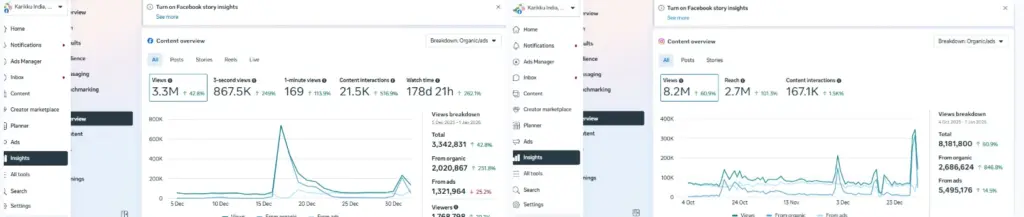
That is why the campaign’s 846% organic-view growth and 262% increase in watch time mattered alongside the total views.
I don’t think a consultant needs to obsess over every metric.
They need to know which number actually matters for the question they are trying to answer.
8. Understanding What Happens After the Enquiry
This is something I pay a lot of attention to, especially with businesses where WhatsApp is a major enquiry channel.
A customer sees an ad.
They click.
They send:
“Price?”
“Location?”
“Details?”
And then what?
How quickly does someone respond?
Is the answer clear?
Does anyone follow up?
Does the sales team know what campaign brought the enquiry?
These things can completely change the final result.
Sometimes I have seen marketers trying to fix the advertisement when the real gap is happening after the lead arrives.
That’s why I don’t like looking at an ad account in isolation.
9. Being Able to Explain Your Thinking
Consulting involves a lot of communication.
You may have to explain an idea to a business owner who doesn’t know marketing terminology.
You may have to tell a designer why a creative isn’t working.
You may have to explain campaign data to a sales team.
And sometimes you have to tell a client:
“I don’t think that’s the problem.”
That conversation needs to be handled properly.
I prefer simple explanations.
What happened?
Why do we think it happened?
What should we try next?
If you can explain your thinking clearly, people can actually act on your recommendation.
10. Knowing What Not to Do
This is one skill I value more now than I did when I started.
When you work in digital marketing, there is always something new.
A new platform.
A new AI tool.
A new trend.
A new content format.
A new campaign option.
It is very easy to keep adding things.
But sometimes the right answer is to do less.
Don’t launch another campaign if the offer is not ready.
Don’t increase the budget if you don’t understand the problem.
Don’t follow a trend just because everyone else is doing it.
Don’t add another tool when the existing process isn’t being used properly.
Experience teaches you that good consulting is not only about knowing what to add.
Sometimes it is about knowing what to remove.
What I Took Away From the Karikku Campaign
When I look back at the Karikku work, the numbers are obviously something we are proud of.
8.18M+ Instagram views.
3.34M+ Facebook video views.
2.7M Instagram reach.
846% growth in organic views.
262% increase in watch time.
But the bigger takeaway for me was the thinking behind those numbers.
We didn’t just ask, “How can we get more views?”
We asked how the brand could become more relevant to the audience.
That changed the way we approached the content.
And that is one reason I believe real campaign experience is so important for anyone who wants to move into brand consulting.
You can learn frameworks.
You can learn tools.
But when you actually put an idea in front of thousands or millions of people, you learn something different.
You learn how the market responds.
Where AI Comes Into This
AI is already changing the way we work.
I use it for research, ideas, content assistance, analysis and repetitive tasks.
It can save a lot of time.
But I don’t think the consultant’s value is going away.
If anything, the question becomes more important:
“Out of all these possibilities, which one should we actually use?”
AI can give me options.
It can help me work faster.
But the context still has to come from the business and the market.
That is where I think human judgement continues to matter.
If You Want to Become a Brand Consultant
If you are starting out, my advice would be simple.
Don’t spend all your time collecting tools.
Take one real business and study it.
Look at its competitors.
Read its reviews.
Study its social media.
Understand its offer.
Look at how people contact the business.
If you get a chance to work on a real campaign, take it seriously.
And after the campaign, don’t just look at whether it “worked” or “failed.”
Ask yourself:
What did I learn from it?
That question will teach you a lot.
Final Thoughts
After 8+ years in digital marketing, I have stopped looking at branding as something that exists separately from marketing.
For me, a brand is experienced through everything a customer sees and interacts with.
The content.
The advertisement.
The website.
The Google search.
The WhatsApp conversation.
The sales interaction.
Even the way a business responds to a simple question.
That is why I don’t think a brand consultant’s job is to sit outside the business and give advice.
The consultant needs to understand what is happening inside the business and then help decide what deserves attention.
If I had to give one piece of advice to someone entering this field, it would be this:
Don’t try to become the person who knows every marketing tool.
Become the person who knows what question to ask before choosing the tool.
That is the difference I have learned through experience.
Frequently Asked Questions
What does a brand consultant do?
A brand consultant helps a business understand its market, define its position, improve its communication and make better brand decisions.
What skills are important for a brand consultant in Kerala?
Customer psychology, local market understanding, positioning, creative direction, offer understanding, digital marketing, data analysis, sales awareness, communication and prioritisation are important skills.
Is digital marketing experience useful for brand consulting?
Yes. Working with real digital campaigns gives a consultant practical exposure to audiences, creative performance, enquiries and campaign data.
Why should a brand consultant understand the Kerala market?
Language, local trust, WhatsApp communication, regional behaviour and NRI/Gulf connections can influence how customers discover and evaluate businesses.
How can I start a career in brand consulting?
Start by working on real businesses and campaigns. Study customers and competitors, learn digital marketing, analyse results and gradually develop your own strategic approach.